What should you do before selling your business?
Get the business ready the usual way first. Clean financial statements, contracts in order, less dependence on you, and a valuation from an adviser. Those steps decide most of the price, and every sale checklist starts with them.
Then there is one step most checklists miss. Your company holds years of work records that AI labs pay for: email, chat, documents, tickets and code. You can license a cleaned copy of those records before you sell. The money comes in once, and the business you sell stays the same.
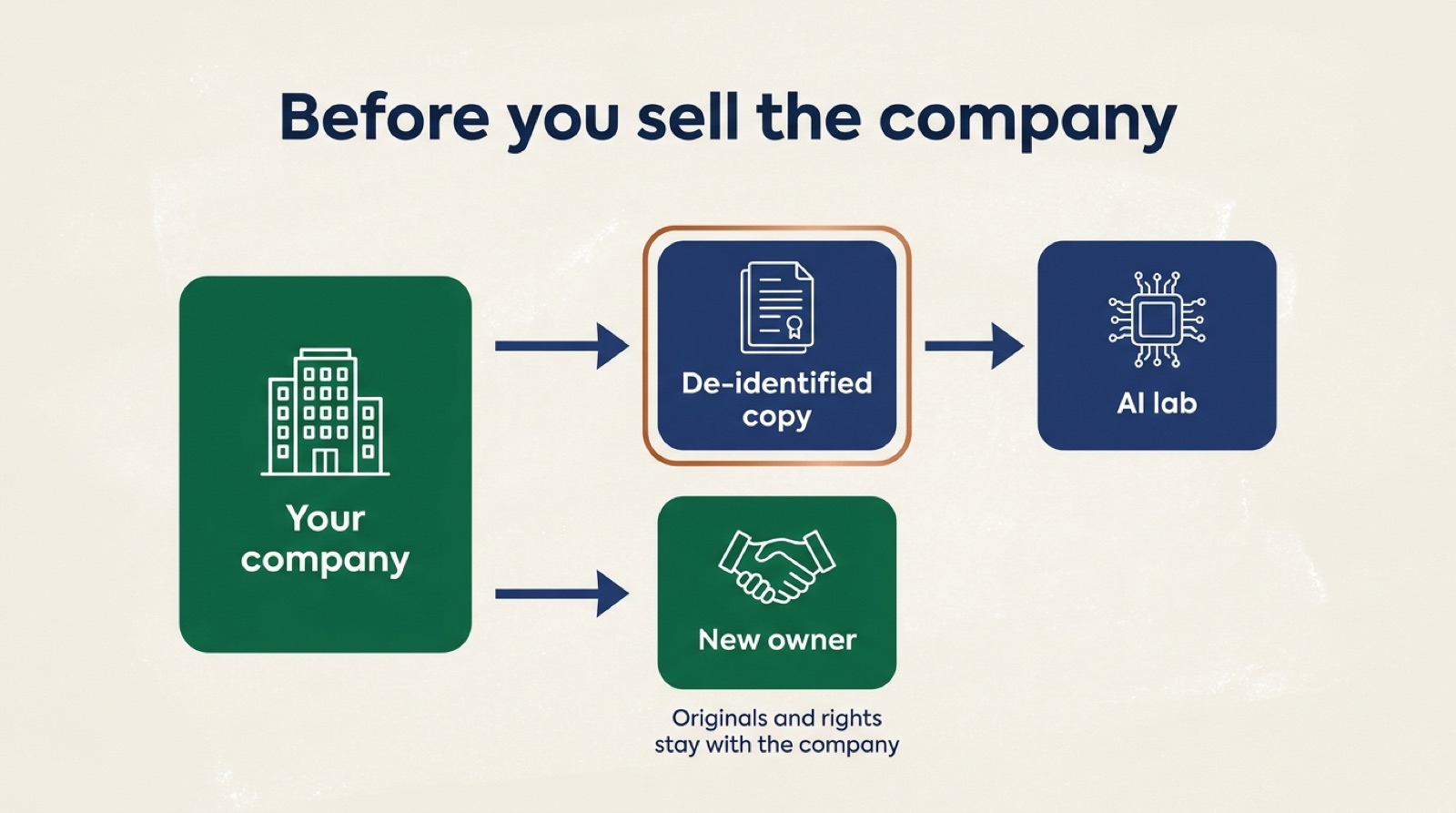
A data licence is written permission to use a copy of data for a set purpose. At Lodex, we buy the right to license a de-identified copy, for one fixed price. Your company keeps its originals and can keep using them as before. That is what makes the step compatible with a sale.
This page is general information, not legal or tax advice. A sale has its own contract, its own adviser and its own tax questions. We point out below where your M&A adviser or lawyer should check.
Closing the company instead of selling it? Then the order of steps is different, and our page on company data when closing a business covers it.
Does licensing a copy of your data lower the sale price?
Usually not. A buyer pays for earnings, customers, staff and contracts. A licensed copy of old email and tickets takes none of those away. The originals, and the right to use them, stay with the company you sell.
Here is what Lodex's seller terms say. You keep ownership of your original data. Lodex gets a licence to the de-identified dataset, and it is non-exclusive unless the data agreement says otherwise. So the company, and later its new owner, can still use its own data in any way it could before.
| After a licence | What the buyer of your company gets |
|---|---|
| The original email, files, tickets and code | All of it, unchanged |
| The right to use those originals | Unchanged |
| Customers, staff, contracts, earnings | Unchanged |
| The de-identified copy | Stays licensed to Lodex, for good |
| The fee you were paid | Already in the company, or paid out before the sale |
The licence on the copy is the one thing that stays. It is perpetual and can't be withdrawn after you sign off the sample. A buyer can't undo it, so the buyer needs to know about it.
When data is what you are selling
There is one exception. If your company's value is the data itself, a licence can matter. Think of a data provider, or software whose edge is a unique dataset. Then a buyer may care who else holds a copy. Talk to your M&A adviser before you license anything. For most firms (an accounting practice, an installer, an agency) the work records are a by-product, not the product.
Will the fee raise the price?
Don't count on it. Buyers usually price a company on a multiple of its normalised earnings. Normalising means stripping out unusual or non-recurring items, as Deloitte explains. A one-off licence fee is exactly that kind of item. So treat it as extra cash next to the sale, not as a way to lift the price.
When should you license: before the LOI, during or after?
Before the letter of intent, if you can. A letter of intent (LOI) is the document in which a buyer sets out the price and terms it intends to offer. After it, most buyers ask for exclusivity and expect you to run the business as usual. A new, permanent licence in that period needs their consent.
Signing earlier keeps it simple. The licence is then a finished contract you disclose, like any other. Signing later turns it into something to negotiate, at the moment you least want extra topics on the table.
License first, then sell. The copy goes to an AI lab, and the company goes to its new owner.
Pick a stage of the sale below to see whether it still works, what to tell the buyer and what to watch.
Pick a stage.
- Does it work?
- Yes, the best moment. Nobody else has a say yet.
- Tell the buyer
- Put the signed agreement in the data room when you open it.
- Watch out
- Tell your M&A adviser before you sign, so it fits the sale plan.
General information, not legal or tax advice. Your M&A adviser or lawyer knows your deal.
How does a data licence show up in due diligence?
As a contract the company signed, so disclose it. Due diligence is the buyer's check of your company before signing: finances, contracts, staff, IT and data protection. The buyer's lawyer will ask for every licence the company has granted. A data licence belongs on that list.
Data protection is part of that check too. The UK regulator, the ICO, says buyers must consider data sharing as part of the due diligence they carry out. A clean, documented licence answers their questions before they ask them.
What to put in the data room
- The data agreement. The sources, the years, the price and the payment terms.
- The data processing agreement that comes with it, for the time before the data was de-identified.
- What stayed out. The sources you excluded, such as HR files and data you hold for clients.
- Your sign-off. The date you approved the cleaned sample.
- The payment. When it came in, or the terms if it hasn't yet.
One practical point: Lodex's terms make the data agreement confidential. Ask Lodex in writing before you share it in a data room, so the buyer and its advisers can read it under their own NDA.
Warranties in the purchase agreement
The purchase agreement will contain warranties: statements about the company that you, as seller, stand behind. There are usually some on intellectual property, material contracts and data protection. Your lawyer lists the data licence against them in the disclosure letter. A licence that is disclosed is a known fact. One that turns up after closing can become a claim.
Share sale or asset sale
In a share sale the buyer takes over the company itself, so the data agreement simply stays with it. In an asset sale the buyer takes chosen assets, and the agreement stays with the company you keep, unless you transfer it. Lodex's terms only allow that transfer with Lodex's written consent. Ask your lawyer which structure applies to your deal.
What about customer and employee data under the GDPR?
The personal details come out before anything leaves, and the GDPR rules still apply until they do. A sale doesn't change that. Neither does a licence.
Until the data is de-identified, Lodex processes it on your behalf as your processor, under a data processing agreement. Names, contact details, account numbers and other identifiers are removed or replaced. Health data and national ID numbers stay out, and so does data you hold for clients as their processor. Our page on how we de-identify company data shows a record before and after.
We won't repeat the legal steps here. The GDPR guide to selling company data covers the lawful basis, what stays out and what to tell people.
Two things matter more when a sale is coming. First, tell your staff what is happening and what is removed. They wrote much of the email and chat, and a buyer will ask whether they knew. Second, keep the paper trail tidy. Your buyer's lawyer reads it in due diligence.
Where does it fit in a sale checklist?
Next to the usual steps, early on, before you approach buyers. Most of the work is yours to plan, and only one step involves Lodex.
- Pick your advisers. An M&A adviser or broker, a lawyer and a tax adviser. Tell them you plan to license data.
- Clean up the financials. Several years of accounts and a view of normalised earnings.
- Reduce dependence on you. Document processes and let your team run the daily work.
- Tidy the contracts. Customers, suppliers, staff and every licence the company has granted.
- License the data copy. Estimate, offer, export, de-identification, sign-off. Before the LOI.
- Build the data room. Include the data agreement, once Lodex agrees to sharing it.
- Approach buyers. With the licence already signed and disclosed.
Step 5 has a side benefit. Running the exports makes you list every tool and archive the company uses, how far back it goes and who runs it. A buyer's IT check asks for the same list. Our guide to preparing company data for an AI lab shows how each export works.
How long does it take, and when is the money paid?
Usually two to three weeks from the first call to a cleaned dataset. Payment follows a buyer, so plan it before your sale timeline gets tight.
- Estimate. Your company size, years in business and country give a first range in a minute.
- Call and offer. We go through your tools and send a fixed price in writing. You can say no.
- Export and cleaning. You or your IT person run each tool's own export and upload it. We remove the personal details.
- Sign-off. You check a cleaned sample and approve it.
- Payment. Within 7 days of the first buyer paying Lodex.

The payment date matters in a sale. The money goes to the company that signed, so it can land after closing. Agree in the purchase agreement who gets it. If the deal is priced cash-free and debt-free, cash in the company is usually settled in the price or paid out before closing. Your adviser picks the route, and the tax that comes with it.
If no lab has paid within the period in the data agreement, either side can end it. The data is then deleted and nobody owes anything. Lodex charges you nothing for any of this.
What should your adviser and lawyer check?
Bring the offer to them before you sign. Five questions cover most of it.
- Is the company's data part of what the buyer is paying for, or a by-product?
- Do any customer or supplier contracts limit what you may do with work records, even cleaned?
- Does an LOI or term sheet you already signed limit new contracts?
- Who should receive the fee, and when: the company, or you through the sale price?
- How is it taxed in your country, for the company and for you?
Then decide whether the data is worth the effort. Company data can fetch €50K–€600K, and strong datasets reach €100K+. Years of history, more people, free text and specialist work push the price up. We work with companies from about 10 people.
Our guide on what your company data is worth explains the factors, and the page for companies shows how a sale with Lodex works. The estimate below gives a first range in a minute.
Questions
Can I sell my company's data and then sell the company?
Yes. With Lodex you license a de-identified copy of the data to AI labs, and the company keeps its originals and its right to use them. The company can then be sold as usual. Disclose the licence to the buyer in due diligence.
Does a data licence make my company worth less?
Usually not, because a buyer pays for earnings, customers, staff and contracts, and those don't change. The exception is a company whose value is the data itself, such as a data provider. Ask your M&A adviser before you license in that case.
Do I have to tell the buyer about the data licence?
Yes. It is a contract the company signed, and the buyer's lawyer will ask for every licence the company has granted. Put it in the data room and let your lawyer list it in the disclosure letter. Ask Lodex in writing before you share the agreement, because it is confidential.
Is the Lodex licence exclusive?
Under Lodex's seller terms the licence is non-exclusive unless the data agreement says otherwise. It covers a de-identified copy, and you keep ownership of the originals. It is perpetual and can't be withdrawn after you sign off the sample.
Can I license the data after signing a letter of intent?
Possibly, but check the LOI first. Most include exclusivity and ask you to run the business as usual, so a new permanent licence then needs the buyer's consent. Licensing before the LOI avoids that.
Who gets the money if it is paid after the sale closes?
The company that signed the data agreement receives it. In a share sale that company now belongs to the buyer, so agree in the purchase agreement who keeps the fee. Your adviser can settle it through the price.
How do I start before selling my business?
Fill in the estimate on this page. It asks for your company size, years in business and country, and gives a first range in a minute. A call and a fixed offer in writing follow, and you can say no.