What if your old repair tickets could make you €100K+?
For a service company with years of history, they can be the core of a dataset worth that much. Most companies treat closed tickets as dead weight. To an AI lab, they are thousands of worked examples of a job done right.
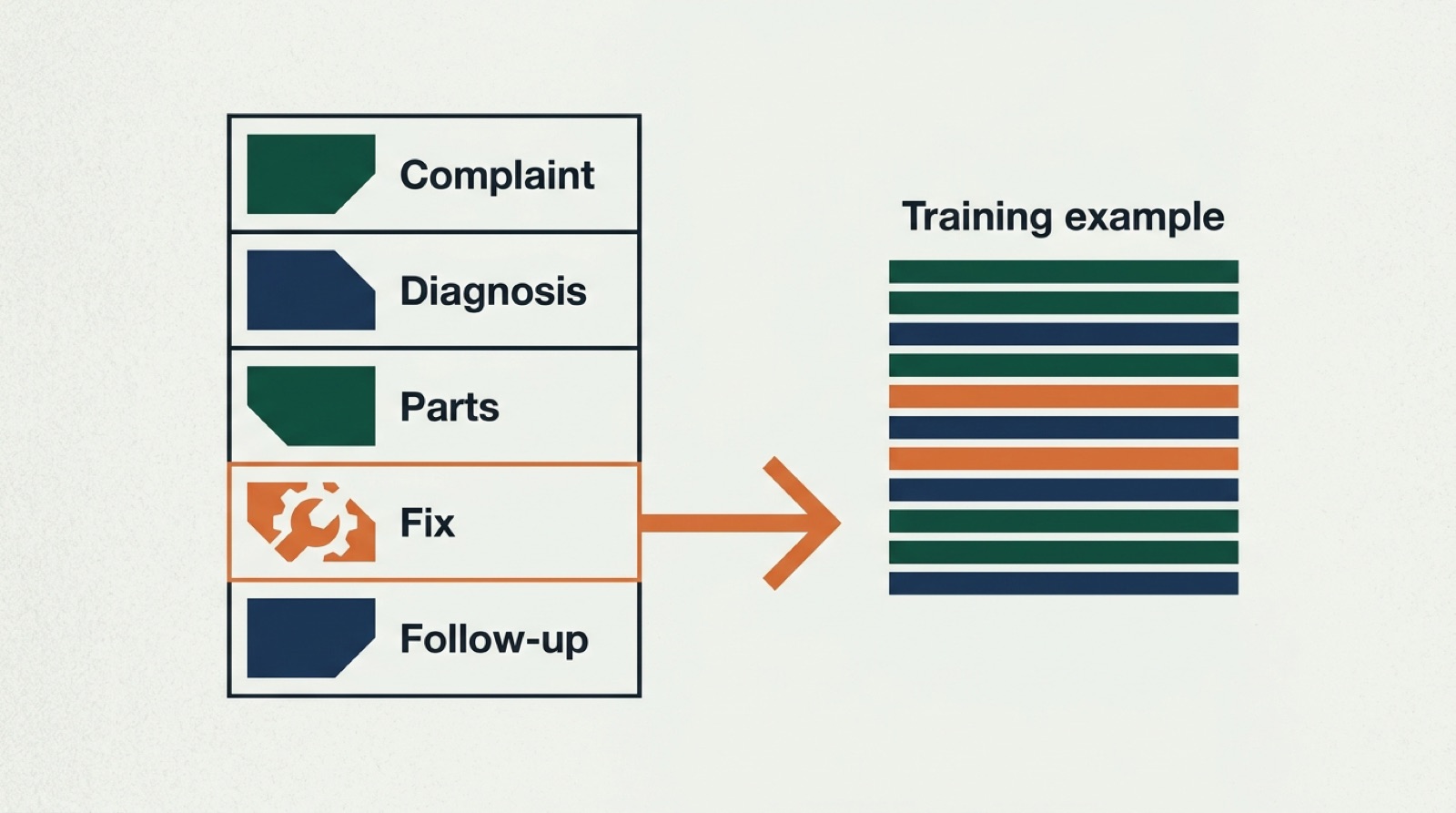
A service record is any trace your team leaves while fixing something for a customer: the fault report, the work order, the technician's notes, the parts used, the invoice and the follow-up call. Each one on its own is ordinary. Ten years of them show how skilled people solve problems.
Lodex buys that history. We remove the customer details, package the records and license them to AI labs that train and test models. You get a fixed price in writing. Your systems keep running as before.
One honest note on the headline. €100K+ is what strong datasets can reach. It is not a yearly income and not a promise. Company data can fetch €10K–€600K, and the price follows what is actually in your records.
Why do AI companies pay for service logs and repair tickets?
Because a closed ticket is a finished task, from first complaint to solution. Labs need exactly that to build AI that can do real work.
A ticket is a complete task
Public text shows answers. It rarely shows the path to the answer. A repair ticket does: the customer's vague complaint, the questions asked, the first wrong guess, the part that was ordered and the fix that held. That sequence is what a model needs to learn to plan and finish a job.
Labs are building agents for field and back-office work
AI labs now build agents: models that should take a request and carry it through on their own. Dispatching a technician, ordering a part, writing up a job and invoicing it are typical tasks. To train and test those agents, labs need thousands of real examples from companies that do this every day.
Buyers already pay service companies
In the US, data firms such as micro1 reportedly pay HVAC companies $150K for their data and know-how, according to The Information. In October 2026 micro1 said it would spend US$1bn in a year buying and licensing operational data from companies, including project histories and quality processes, according to The Next Web. Lodex brings that demand to European service companies.
What does a repair ticket teach an AI model?
More than you'd think. Click through the parts of a typical ticket below. Each part teaches something different, and the marked details are what we remove first.
Pick a part of the ticket.
- Complaint
Mrs Jansen, Lindenlaan 12: heating stops every morning around 7, display shows E4. Reset helps for a day.
- What a lab learns
- How customers describe a fault in their own words, vague and incomplete.
- Removed before it leaves
- Customer name and address.
A made-up example. Real tickets are cleaned the same way.
The value grows when tickets link to each other. A boiler that comes back three times in two years, with a different fix each time, teaches a model about root causes. Your records hold hundreds of those stories.
Which service records count?
Almost everything your service desk and your technicians produce. The table shows the common ones.
| Record | What's in it | What a lab learns | What we remove |
|---|---|---|---|
| Repair tickets and fault reports | Complaint, questions, diagnosis, fix | How a fault is narrowed down and solved | Customer names, addresses, phone numbers |
| Work orders | Job, technician notes, hours, parts | How a job is planned and written up | Names, addresses, account references |
| Service and maintenance logs | Visits, readings, findings over years | How equipment ages and fails | Customer and site details |
| Schedules and dispatch | Who went where, in what order, rescheduling | How a day of jobs is planned and replanned | Names, addresses, licence plates |
| Quotes and invoices | Scope, materials, prices | How a job is priced and billed | Customer names, IBANs, account numbers |
| Help desk tickets | Questions and answers in IT or customer service | How a support question is diagnosed and closed | Customer names, emails, order numbers |
For trade businesses specifically, our page on selling construction and trades company data lists the systems we see most. For IT service desks, see selling IT company code and ticket data.
What if AI companies paid you for your old schedules and logs?
They do, as part of a dataset. Schedules and logs are rarely worth much on their own. Next to the tickets and work orders they belong to, they add the part labs find hardest to get: time.
A dispatch schedule shows how a planner fits 40 jobs into a day, then moves 12 of them when two technicians call in sick. A maintenance log shows the same machine visited every quarter for eight years, with readings that slowly drift before it fails. Neither shows up anywhere on the public web.
A schedule shows how work is planned. A log shows what happened next. Together they show judgement.
So when we assess your data, we look at how your records link: ticket to work order, work order to schedule, schedule to invoice. The more of that chain you have, the more a dataset is worth.
How much are old service records worth?
Company data can fetch €10K–€600K. Service datasets with many years of linked tickets, work orders and logs can reach €100K+ and more. The estimate at the bottom of this page gives a first range in a minute.
- Years of history. Ten years of tickets beats two, because the same fault appears many times.
- Volume. More technicians and more jobs mean more examples.
- Free text. Technician notes in their own words are worth more than tick boxes.
- Links. Tickets that connect to work orders, parts and invoices are worth more than loose files.
- Specialisation and language. Lift maintenance in German or solar installs in Dutch are hard to find elsewhere.
Our guide on what your company data is worth explains each factor in more detail.
Which service companies can sell their records?
Companies from about 10 people with several years of logged work. The kind of service matters less than how deep the records go.
- Installers, HVAC, plumbing and electrical firms.
- Maintenance companies for lifts, machines, fire safety or building systems.
- Facility and cleaning companies with schedules and inspection rounds.
- IT service desks and managed service providers.
- Repair shops and the service departments of equipment makers.
Some records stay out whatever the company. Data you keep for a client inside the client's own systems is theirs. Health data and national ID numbers are excluded. A home care company's visit logs, for example, are full of health details, so they stay out.
A company that keeps its job sheets only on paper is usually too early. If the work order lives in a binder in the van, there is little to license yet. Start logging every job digitally now, and come back once you have a few years of records.
Is it really pure profit?
Close to it. The records already exist, so there is nothing to produce. Lodex charges you nothing. Your cost is time: a short call, giving read-only access or an export, and checking a cleaned sample.
It is not risk-free in the sense that nothing could ever go wrong. Customer data is involved, and that needs care. What we do is take the risks out one by one, in writing, before anything leaves.
- Customer names, addresses, phone numbers, emails and account numbers are removed.
- No re-identification key is kept, by us or anyone else.
- Access is read-only and encrypted, under NDA from day one.
- You check a cleaned sample and sign off before anything is licensed.
- We license only to AI labs and research teams under contract, never to your competitors.
- Our copy of the originals is deleted once processing is done.
Our page on how we anonymise company data shows a record before and after cleaning.
How do you get service data out of your systems?
Usually with an export your software already has. Most field service, ticketing and planning tools can export jobs, tickets and notes as files. Where there is no export, read-only access to the source works too.
- Estimate. Your company size, years in business and country give a first range.
- Call. We go through your systems and agree which records are in and which stay out.
- Offer. A fixed price in writing. You can say no.
- Export or access. We tell you exactly which export to run, or connect read-only.
- Cleaning and approval. We remove customer details, you check a sample and sign off.
- Payment. Within 7 days after the data passes review.
A lot of service work also lives in email and chat: the customer's photo of an error code, the planner's message to a technician, the supplier's reply about a part. Those count too, cleaned the same way.
Every step is explained in how to sell business data. If you want to understand the licence itself, read licensing company data to AI.
Questions
Are old repair tickets really worth money?
Yes, to AI labs. A closed repair ticket shows a real problem being diagnosed and fixed, which is what labs need to train and test AI agents. Years of tickets from a company of about 10 people or more are often worth selling.
Can I sell work orders and maintenance logs?
Yes. Work orders, maintenance logs, schedules, quotes and invoices all count, especially when they link to the tickets they belong to. Customer details are removed before anything is licensed.
Will customers' names and addresses be shared?
No. Customer names, addresses, phone numbers, emails and account numbers are removed before the data leaves. You check a cleaned sample and approve it before any lab gets it.
Is this a yearly income?
No. Each licence is a fixed price agreed in writing, paid within 7 days after the data passes review. New tickets keep building up, so newer records can be licensed again later.
Which service companies does Lodex work with?
Installers, HVAC and plumbing firms, maintenance and facility companies, IT service desks, repair shops and other companies that log service work. A good fit has about 10 or more people and several years of records.
Do I need to clean or sort the tickets first?
No. We tell you which export to run or connect read-only, and we do the cleaning. You only check a cleaned sample at the end.