Can you sell your company's Slack data?
Yes. A company can sell a de-identified copy of its Slack history, and the same goes for Microsoft Teams, Jira and the other tools your team works in. We buy that copy, clean it and license it to AI labs that train and test models. Your workspace keeps running as before.
You don't sell the workspace or the tool. You grant a licence: written permission for a buyer to use a copy of your data under set terms. The originals stay with you, and you can keep using them.
Two things decide whether a sale can go ahead. The data must be yours to sell, and the way it leaves the tool must fit that tool's terms. We cover both below, tool by tool. Companies from about 10 people take part, and we handle records in 8 languages.
Why do AI labs pay for Slack, Teams and Jira history?
Because it shows how work really gets done. Public text on the internet is mostly finished work: articles, manuals, answers. Your tools hold the messy middle: the question, the wrong first guess, the fix and the sign-off.
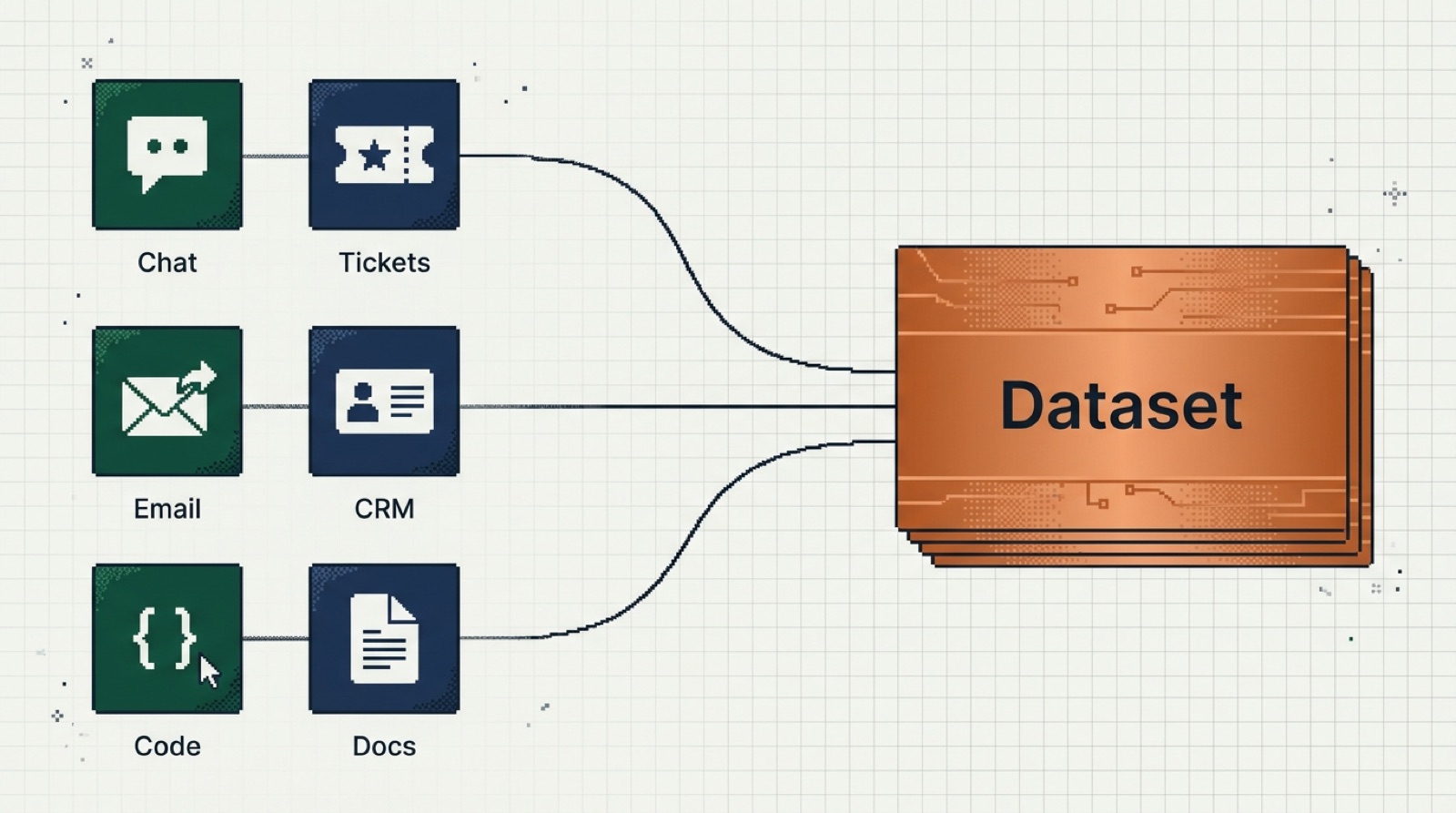
Labs now build AI agents that are meant to work inside companies. An agent that files a ticket, answers a customer or reviews code needs examples of people doing exactly that. A Slack thread where three colleagues decide whether to delay a release is such an example. So is a Jira ticket that moves from bug report to merged fix in eleven steps.
Your Slack, Teams and Jira history is a record of decisions. That is what AI labs can't find on the public web.
Our guide on what AI labs buy from companies explains the wider demand. This page sticks to the tools.
Which tools do we buy data from, and what do labs learn from each?
We buy from the tools most European companies run on: chat, tickets and wikis, email, CRM, help desks, code and documents. Each one teaches a model something different. Pick yours below to see what.
Pick the tools your company uses.
3 selected
- Slack ChatHow a team discusses options and settles on a decision.
- Microsoft Teams ChatHow work is handed off between people and departments.
- Jira TicketsHow a problem moves from report to fix, step by step.
| Tool | What's in it | What labs learn | What we strip |
|---|---|---|---|
| Slack, Microsoft Teams | Channel threads, replies, shared files | How a team reaches a decision and hands off work | Names, handles, emails, phone numbers, customer names |
| Jira, Confluence | Tickets, status changes, comments, wiki pages | How a problem moves from report to fix, and how knowledge is written down | Assignees, reporters, customer and account references |
| Email (Microsoft 365, Google Workspace) | Threads with clients, suppliers and colleagues | How professionals write, negotiate and follow up | Names, signatures, addresses, phone numbers |
| CRM (Salesforce, HubSpot) | Deals, notes, activity history | How a sale progresses and why deals are won or lost | Contact names, company names, account and IBAN numbers |
| Help desks (Zendesk, Freshdesk) | Tickets, replies, macros | How a support question is diagnosed and solved | Customer names, order numbers, contact details |
| Code (GitHub, GitLab) | Repositories, commits, pull requests, reviews | How real software changes and how reviewers judge it | Author names, emails, secrets and keys |
| Documents (Notion, SharePoint, Google Drive) | Procedures, templates, reports, drafts | How a company structures its work | Names, client details, addresses |
Chat: Slack and Microsoft Teams
Chat is where decisions happen in public channels. A thread shows who raised a problem, which options came up and what was chosen. Labs use this to teach models to follow a conversation with several people and pick out the decision. Public channels in a busy team are the core of a chat dataset.
Tickets and wikis: Jira and Confluence
A ticket history is the full log of a work item: who reported it, every status change, every comment, the linked code. It shows a problem moving from report to fix in order. Confluence pages add the written procedures behind that work. Together they teach a model to plan and finish multi-step tasks, which is what agents struggle with most.
Email and CRM
Email shows how professionals write to clients and suppliers. A CRM adds structure: a deal, its stages, and notes on why it moved or stalled. A model learns from both how a sale or a negotiation runs over weeks, not just in one message.
Help desks
Support tickets pair a real question with the answer that solved it. Many also carry a category and a resolution time. That makes them close to ready-made training examples for customer service models.
Code and documents
A code repository with its commit history and review comments shows how software changes in practice, not just what the final version looks like. Documents in Notion, SharePoint or Google Drive hold procedures, templates and reports. If your company runs IT projects for clients, see what changes for IT services firms.
What is your Slack or Jira history worth?
Company data can fetch €10K–€600K. Larger or specialised datasets can earn up to hundreds of thousands of euros. That is a ceiling for the best cases, not a typical price and not a promise.
Where you land depends on the data itself. These factors move the price most:
- Years of history. Eight years of Jira tickets say more than eight months.
- Linked sources. A ticket that links to the Slack thread and the code change is worth more than each on its own.
- Specialisation. A niche engineering firm's tickets are rarer than a general office's chat.
- Language. Dutch, German or Polish work records are scarcer in training data than English ones.
- Activity. Threads with real back-and-forth beat channels full of bot alerts.
The estimate on this page uses your company size and years in business for a first range. The final offer follows from the sources you include. For the full reasoning, read why business data is worth money and our guide on what your company data is worth.
Do Slack, Microsoft and Atlassian terms allow you to sell your data?
Each tool has its own terms, and they matter. Some limit how data may leave the tool, so the export route is part of the deal. Here is what we found when we checked in October 2026. Your own contract with each vendor still comes first, and we go through it with you before anything is exported.
Slack
Slack's API Terms of Service changed in 2025. Third-party apps may no longer use data from Slack's API to train a large language model, may not bulk export message and file data, and may not keep long-term copies of other organisations' data. These rules bind app developers that serve other organisations.
So a sale should not run through an outside app that pulls your workspace over the API. The route that fits is Slack's own export tool, used by your workspace owner. Slack's guide to data exports sets out what each plan allows:
- Free and Pro: owners and admins can export public channels. Private channels and direct messages need valid legal process, consent of members, or a requirement or right under applicable law.
- Business+ and Enterprise: owners can apply for a tool that exports all channels and conversations. Slack expects the owner to have the right employment agreements and policies in place, and to make sure the use is permitted by law.
In practice most Slack sales are built on public channels. Direct messages are personal and usually stay out.
Microsoft Teams, Outlook and SharePoint
Microsoft 365 admins can export Teams conversations, mailboxes and SharePoint or OneDrive files with Microsoft Purview eDiscovery. The user running the export needs a Microsoft 365 E3 or E5 licence. The same rule applies as with Slack: you or your admin make the export, and you decide what goes in it.
Jira and Confluence
Atlassian's customer agreement states that the customer owns its customer data, and Atlassian's documentation describes how to retrieve it. Atlassian's developer terms separately forbid Marketplace apps from selling end-user data. So here too, the export is made by your own admin with Atlassian's tools, not by a third-party app.
Other tools, such as Salesforce, HubSpot, Zendesk, GitHub and Notion, have admin exports as well. Their terms differ. We check each tool's terms with you before extraction, and the written scope records what is in and out.
How does a sale of tool data work, step by step?
A sale takes about two to three weeks from first call to payment. These are the steps:

- Estimate. Two questions on this page give you a payout range in a minute.
- Call. In 20 minutes we go over your tools and agree in writing which channels, projects and mailboxes are in, and which are out.
- Offer. We assess the sources and make a fixed price offer in writing. You are not obliged to accept.
- Secure handover. Your admin makes the export with the tool's own export function, and you hand it over through an encrypted channel or grant read-only access to the sources you approved. Everything is under NDA from day one.
- Cleaning. We remove names, customer details and other identifiers during processing.
- Your approval. You check a cleaned sample and sign off. Nothing is sold without it.
- Payment. The money is in your account within 7 days after the data passes review.
The full walk-through, including who does what on your side, is in our guide on how to sell business data.
What do we remove from Slack, Teams and Jira data?
We deliver the data fully anonymised: nobody, including us, can link a record back to a person or a customer. We don't just swap names for codes and keep a key. Pseudonymised data with a key is still personal data under the GDPR, so we keep no key at all.
In practice that means:
- Names, @handles, email addresses and phone numbers are removed from messages, tickets and commits.
- Customer names, account numbers, IBAN numbers and addresses are removed.
- Health data and national ID numbers are excluded entirely.
- Secrets in code, such as API keys and passwords, are stripped.
- Your originals are deleted on our side once processing is done.
Take a Jira comment like "Anna, the Rotterdam client says invoice 4471 failed again." After cleaning, the comment keeps the work and loses the people: a colleague, a client, an invoice that failed. See before-and-after examples in how we anonymise company data.
What stays out of a sale?
Some data is not yours to sell, even if it sits in your tools. It stays out, whatever the price.
- Client data you process as a processor. If you run a help desk or a Jira project inside a client's systems on their behalf, that data serves the client's purposes.
- Client-confidential material. Law firms, accountants and medical practices need extra care, and privileged content stays out.
- Direct messages and private channels unless you have the right to export them under the tool's rules and the law.
- Shared channels with other companies. Slack Connect and shared Teams channels hold another organisation's messages too.
The GDPR side, including the purpose test, staff notice and your works council, is covered in our guide on whether it is legal to sell company data under the GDPR.
Who buys the data, and who never sees it?
We license only to AI labs and research teams under a written contract. Never to your competitors. Nothing is published.
Buyers first see redacted samples only. The full package is released after they pay. Each lab gets a copy for training and testing models, under terms that set what it may do with it.
If your company is winding down or in insolvency, the same tools can still be sold through the administrator. That route has its own rules, set out in selling data from a bankrupt company.
Questions
Can I sell our Slack history?
Usually yes, if the history belongs to your company and you export it with Slack's own export tool. Slack's API terms bar outside apps from using API data to train language models, so a sale should not run through such an app. Public channels are the normal starting point; private channels and direct messages need an extra legal basis.
Can I sell Microsoft Teams data?
Yes, a de-identified copy of Teams channel conversations can be licensed like Slack data. Your Microsoft 365 admin can export it with Microsoft Purview eDiscovery, which needs an E3 or E5 licence. You decide which teams and channels go in.
Can a company sell its Jira data?
Yes. Atlassian's customer agreement says the customer owns its data, and your admin can export it with Atlassian's own tools. Jira tickets are valuable to AI labs because they show a problem moving from report to fix, step by step.
Is Slack data used for AI training?
AI labs train and test models on licensed work conversations, including chat from tools like Slack, to teach agents how teams decide and hand off work. Slack's API terms bar third-party apps from using API data to train language models. An export made by the company itself with Slack's own tool is a different route.
How much money can we earn with Slack, Teams and Jira data?
Company data can fetch €10K–€600K, and larger or specialised datasets can earn up to hundreds of thousands of euros. The price depends on years of history, linked sources, specialisation and language. The estimate form gives a first range in a minute.
Do we lose access to our Slack or Jira workspace?
No. You license a copy and keep the originals. Your team keeps working in the same tools, and nothing changes in your workspace.
Will our employees' names end up with an AI lab?
No. Names, handles, email addresses and phone numbers are removed during processing, and no re-identification key is kept by anyone. You check a cleaned sample and sign off before anything is sold.
This page describes vendor terms as we read them in October 2026. It is not legal advice; check your own contracts.