Is my business data worth money?
For most companies with about 10 or more people and a few years of history, the answer is yes. The value sits in records you already keep for other reasons. Nobody has to create anything new.
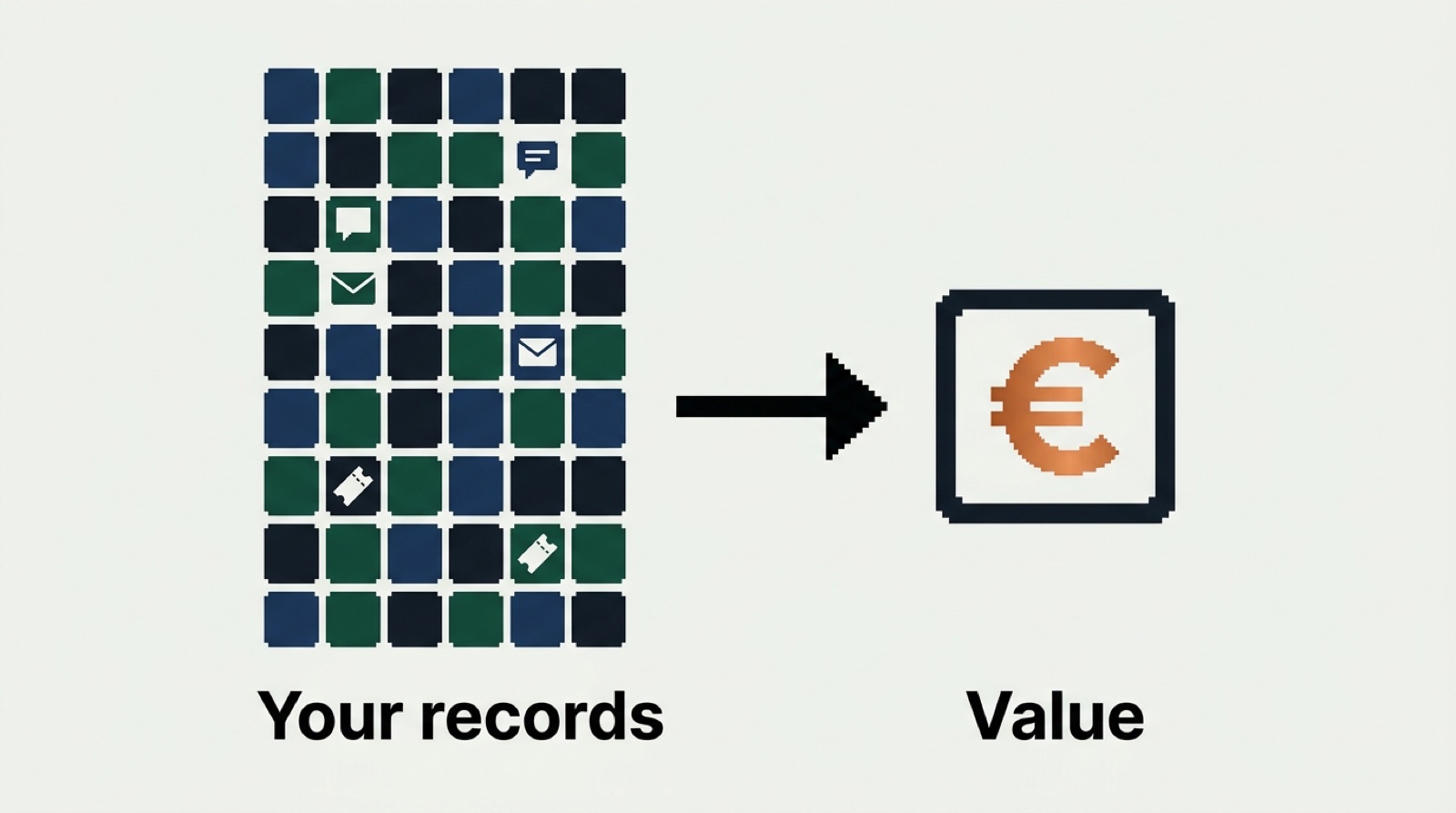
Work data is the trail your company leaves while it works: messages, emails, tickets, files, code and system records. Each item is ordinary on its own. Together, over years, they show how real people solve real problems. That is exactly what AI labs lack.
Lodex buys that data. We remove names and other identifiers, package it, and license it to AI labs that train and test models. You decide which sources go in. You get paid a fixed price agreed in writing.
This page is the broad picture: why the demand exists, what counts, who can earn and what the options are. For the detailed price factors, read what drives the price of company data.
Why do AI companies pay for data now?
Because the public web is running out, and it never taught models how work gets done. Labs need records from inside companies, and they are willing to pay for them.
The public text is nearly used up
The first large language models learned from websites, books, forums and public code. Researchers at Epoch AI estimate the stock of good public human text at about 300 trillion tokens. Their June 2024 study expects models to use it all up somewhere between 2026 and 2032. You can read the method in Epoch AI's study on running out of training data.
Labs now want records of real work
Labs now build AI agents: models that should resolve a ticket, reconcile a ledger or update a CRM on their own. Public text shows the finished result, if anything. It rarely shows the request, the back and forth, the mistake and the fix.
Your records do. A support ticket from first message to solution is a complete example of a task done well. So is a Slack thread where two colleagues argue about how to book a transaction and settle it. Our guide on what AI labs buy goes through the categories one by one.
Large buyers already pay real money
In August 2026 Google paid US$10M in a US bankruptcy auction for Spirit Airlines' internal data. The package held about 100 million emails, 500 million Microsoft Teams chats and 30 million lines of code, with passenger profiles excluded, as SiliconANGLE reported. An airline is not a 40-person firm. But the deal shows what labs are looking for: ordinary internal records, at scale.
What in a normal company is worth money?
The things you stopped noticing. Most of the value sits in tools your team opens every day and never thinks of as an asset.
- Chat. Years of Slack or Microsoft Teams messages, where questions get asked and decisions get made.
- Email. Threads with suppliers, partners and colleagues that show how work moves between people.
- Tickets. Support desks, Jira boards and service queues, each one a task with a start and an end.
- Documents. Procedures, templates, reports, proposals and the drafts that led to them.
- Code. Private repositories with their history, review comments and the tickets behind each change.
- Records. CRM, ERP and accounting entries that show the steps of a process.
Take a 30-person accounting firm with twelve years of email and a ticket tool. Every month-end close, every client question and every correction by a senior is in there. To a lab, that is a library of worked examples. Our page on selling Slack, Teams and Jira data covers the tools one at a time.
Some data is not yours to sell. Records you hold for clients as a processor stay out. So do health data and national ID numbers.
How much can business data be worth?
Company data can fetch €10K–€600K. Larger or specialised datasets can earn up to hundreds of thousands of euros. That is a ceiling for the strongest datasets, not a typical result or a promise.
Three facts predict a first range well: how many people produce records, how long you have been in business and how large the operation is. Move the sliders below to see how those three change the estimate. It uses the same model as the estimate form at the bottom of this page.
Estimated payout
€36K to €52K
An estimate. The final offer follows your sources and our review.
The final price depends on what is actually in your sources. Years of history, structure, specialisation, language and cleanliness all move it. A firm that works in Dutch and German, for example, often holds records labs can barely find elsewhere. The guide to what your company data is worth explains each factor and the public deals behind them.
Can small businesses sell their data?
Yes. Lodex works with companies from about 10 people. Size helps, but it is not the main thing. Depth and specialisation often matter more.

Two kinds of companies tend to do well. Older companies have more history, so the same task appears hundreds of times, done by different people in different years. Specialised companies do work few others do, so their records fill a real gap. A 15-person customs broker with twenty years of email can be worth more than a 200-person firm with two years of loose files.
- Professional services: accountants, law firms, consultancies and IT service providers.
- Operations-heavy firms: logistics, wholesale, field service and installation companies.
- Software companies with private code and a ticket history.
- Companies that work in several European languages.
- Companies that are winding down, where the data would otherwise be deleted. See what happens to company data in a bankruptcy.
A brand-new company with a year of records is usually too early. Data from a few months of work rarely shows enough repeated tasks for a lab to learn from.
What are the ways to make money from company data?
There are four realistic options. Licensing a cleaned copy to AI labs is the newest and, for most companies, the simplest. Here is how they compare.
| License to AI labs via Lodex | Sell to a data broker | Build your own data product | Do nothing | |
|---|---|---|---|---|
| What is sold | A cleaned copy of work records | Mostly contact and customer lists | Benchmarks, reports or an API you design | Nothing |
| Personal data | Removed before anything is sold | Often the whole point, so GDPR risk is high | Up to you to remove | Stays in your systems |
| Effort for you | One call, read-only access, approve a sample | Moderate, and you carry the legal risk | A team, a product and years of sales | None |
| Who buys | AI labs and research teams under contract | Marketers and other brokers | Customers you find yourself | Nobody |
| Money | Fixed price in writing, paid within 7 days after review | Usually small and uncertain | Possibly large, but slow and unproven | Zero, plus storage costs |
| Your originals | You keep them | Often you keep them | You keep them | You keep them |
Building your own data product can make sense for a company whose data is its core business, such as a price index or a market research firm. For everyone else it is a second company to run.
Selling customer lists to a broker is the option we advise against. Under the GDPR it usually needs consent you do not have, and it can cost you the trust of the very customers on the list.
Is company data an asset?
In practice, yes, though your accounts do not say so. An asset is something you own that can bring in money. Your archive of work records fits that definition once there is a buyer for it. Until recently there was none.
Most companies treat old data as a cost. It takes storage, it needs backups, and it is a risk if it leaks. That view made sense when nobody would pay for it. It makes less sense now that labs do.
Your archive is not just a cost to store. For an AI lab it is a record of how skilled people do their jobs.
Nobody knows how long this window stays open. Labs may find other sources, or generate more of their own data. Companies that license now sell into a market that is clearly paying today.
What do you give up when you license your data?
Nothing you use. You license a copy: you grant an AI lab the right to use a cleaned copy of your records for training and testing. You keep the originals and keep working with them as before.
Your Slack stays your Slack. Your ticket tool keeps running. Nothing is moved, closed or handed over. We connect read-only, take a copy of the sources you approve, and delete our copy of the originals once processing is done.
The agreement states what is included, who may use it and for what. Nothing is published. We license only to AI labs and research teams under contract, never to your competitors.
What are the risks, and how does Lodex handle them?
The real risks are about people and trust: a customer's name in a ticket, an employee's phone number in an email, a client secret in a document. Lodex delivers data that is fully anonymised. That claim rests on specific steps.
- Identifiers are removed: names, email addresses, phone numbers, customer names, account and IBAN numbers, and addresses.
- No re-identification key is kept, by us or by anyone else.
- Health data and national ID numbers are excluded altogether.
- Originals are deleted once processing is done.
- You check a cleaned sample and sign off before anything is sold.
- Buyers see redacted samples only. The full package is released after they pay.
This is different from pseudonymised data, where names are swapped for codes and someone keeps the key. Under the GDPR that is still personal data. Lodex keeps no key. Our GDPR guide to selling company data explains the legal side, and how we anonymise company data shows the cleaning in detail.
Client-confidential material needs extra care. For law firms, accountants and medical practices, some sources stay out entirely. We agree that in writing before we connect.
How do you find out what your data is worth?
Start with the estimate. It takes about a minute and commits you to nothing. From first call to payment usually takes two to three weeks.
- Estimate. Pick your company size and years in business to see a payout range.
- Call. In 20 minutes we go over your sources and agree in writing what is in and what is out.
- Offer. We assess the data and make a fixed offer in writing. You are free to say no.
- Handover. Encrypted, read-only access to the sources you approve, under NDA from day one.
- Cleaning. We remove names, customer details and other identifiers.
- Approval. You check a cleaned sample and sign off. Nothing is sold without it.
- Payment. The money is in your account within 7 days after the data passes review.
Each step is explained in more depth in how to sell business data.
Questions
How do I know if my company's data is worth anything?
If your company has about 10 or more people and several years of email, chat, tickets or documents, it very likely has value to AI labs. The estimate on this page gives a first range in about a minute. A short call then shows which sources count most.
Why would an AI company pay for my emails and chats?
Models learned mostly from public text, which shows finished results but rarely how work gets done. Your emails and chats show requests, decisions and corrections in real context. Labs use that to train and test AI agents that do office work.
Can I make money from company data without selling customer data?
Yes. What labs want is how work is done, not who your customers are. Customer names, contact details and account numbers are removed before anything is sold, and data you hold for clients as a processor stays out.
Do I lose ownership of my data if I license it?
No. You license a cleaned copy for AI training and testing. The originals stay in your systems and you keep using them. The agreement states exactly what the buyer may do with the copy.
Is the payout a one-off or recurring?
Each sale is a fixed price agreed in writing and paid within 7 days after the data passes review. New records keep building up in your tools, so a later sale of newer data is possible.
Will my competitors be able to buy my data?
No. Lodex licenses only to AI labs and research teams under contract, never to your competitors. Nothing is published, and buyers see redacted samples only until they pay.
Can a company in bankruptcy or liquidation sell its data?
Often yes, through the administrator or curator, who decides on the sale of company assets. Data from a company that is winding down would otherwise usually be deleted. Our page on bankrupt company data explains how it works.
This page is general information, not legal advice.