What does it mean to license company data to AI?
A data licence is written permission to use a copy of your data, for a set purpose, on set terms. You stay the owner. The buyer gets a right of use, not your archive.
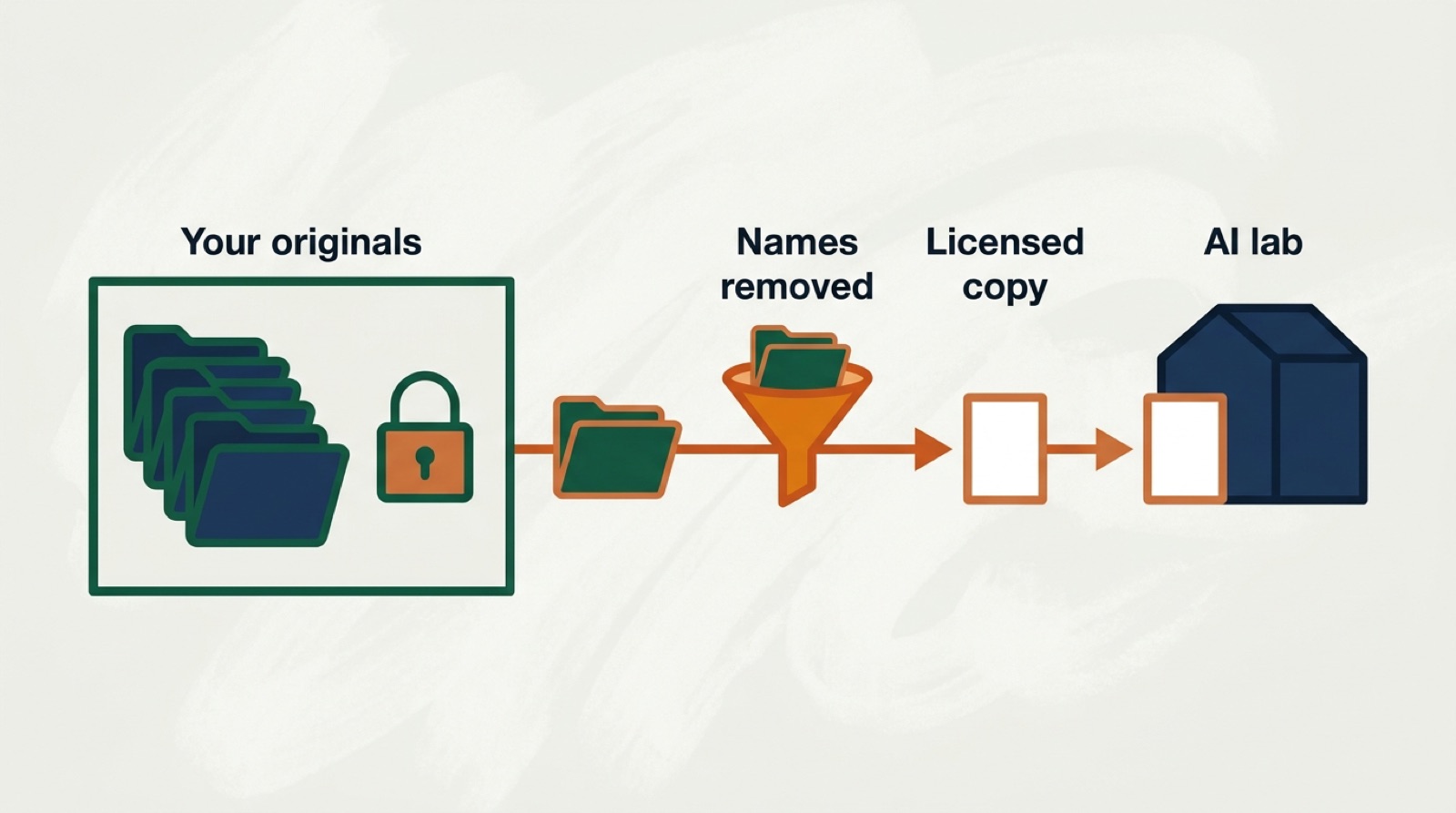
For an AI lab, that right of use is all it needs. Labs train models on real examples of work and test them on realistic tasks. They want your years of email, chat, tickets, documents and records because those show how skilled people actually get things done.
Lodex sits in the middle. We take a copy of the sources you approve, remove names and other identifiers, and license the cleaned result to AI labs and research teams under contract. You get a fixed price in writing. Your systems keep running as before.
That is why people call it renting out your data. The records never leave your hands. What leaves is a cleaned copy, with a contract that says who may use it and for what.
Can you rent out old records without exposing client names?
Yes. That is the whole design. Labs need to see how a task was done, not who it was done for. So client names, contact details and anything else that points to a person or a company are removed before the copy leaves.
What gets removed
- Names of people: employees, clients, suppliers and contacts.
- Customer and company names.
- Email addresses, phone numbers and street addresses.
- Account numbers, IBANs and other references to a customer or a payment.
What stays out altogether
Some data never goes in, cleaned or not. Health data and national ID numbers are excluded. So is data you hold for clients as a processor, such as records you host inside a client's own systems. We agree in writing which sources are in and which are out before we connect.
What you check before anything is licensed
You see a cleaned sample and sign off before any lab gets the package. Buyers see redacted samples only, and the full package is released after they pay. No re-identification key is kept, by us or anyone else. Our page on how we anonymise company data shows the before and after in detail.
Licensing vs selling your data: what is the difference?
Selling outright transfers the data. Licensing grants a use and keeps the data yours. For company records, licensing is almost always the better deal, because you still need those records to run your business.
- Your originals
- Stay in your systems. You keep using them.
- Client names
- Removed before the copy leaves.
- What the buyer may do
- Train and test AI models, as the licence says.
- Who can buy
- AI labs and research teams under contract. Never your competitors.
- Newer records
- Can be licensed again later.
Lodex always licenses a cleaned copy.
| Licensing a copy | Selling outright | |
|---|---|---|
| Who owns the originals | You do | Often the buyer |
| Can you keep using them | Yes, nothing changes | Depends on the contract |
| What the buyer may do | Train and test AI models, as the licence says | Whatever the contract allows |
| Client names | Removed before the copy leaves | Depends on the buyer |
| Newer records later | Can be licensed again | Usually a new negotiation |
In daily speech the words blur. Our other pages say "sell your data" because that is what people search for. What actually happens at Lodex is always a licence on a cleaned copy.
How much can you make licensing company data to AI?
Company data can fetch €10K–€600K. Datasets with many years of history, many people producing records or rare specialised work can reach €100K+ and more. That is a range, not a promise. The final price follows what is actually in your sources.
Public deals show the scale of the market. In February 2024 Reddit licensed its content to Google for AI training, in a deal Reuters put at about US$60M a year, as Engadget reported. In October 2026 the data company micro1 said it would spend US$1bn in twelve months buying and licensing operational data from companies, with tiers starting above US$100,000 for a qualified partnership, according to The Next Web.
A 40-person firm is not Reddit. But the price drivers are the same ones Reddit had: volume, years of history and how hard the data is to find elsewhere. Our guide on what your company data is worth goes through each factor.
- Years of history. The same task done hundreds of times, by different people, is what a model learns from.
- Number of people. More people means more records and more ways of working.
- Specialisation. Customs brokers, installers and tax advisers hold records few others have.
- Language. Records in Dutch, German, Polish or Swedish are scarcer than English ones.
Is it a royalty check or a one-off fee?
At Lodex it is a fixed fee per licence, paid within 7 days after the data passes review. There is no royalty that depends on how a model later performs, and no yearly check you have to wait for.
That is a choice, and it is in your favour. A royalty is a share of future revenue. To check one, you would need to see how a lab uses your data inside its models, and no lab will show you that. A fixed price in writing is something you can actually hold someone to.
A fixed price you can check beats a royalty you can't.
Can it become money every year? Possibly. Your company keeps producing records. A year or two after a first licence, the newer emails, tickets and files can be licensed again as a new dataset. We can't promise that a lab will want them, so we don't sell it as a yearly income.
Is licensing your data to AI legal and secure?
Yes, when it is done properly. Three things have to be right: the privacy law, your own contracts and the handover itself.
Under the GDPR
The GDPR does not apply to data that is truly anonymised, where nobody can trace a record back to a person. That is why we remove identifiers and keep no key. Until that point, the data is personal data and you need a lawful basis to hand it over for processing. Our GDPR guide to selling company data explains both steps.
Under your own contracts
Some client contracts limit what you may do with work you did for them, even in cleaned form. Law firms, accountants and medical practices know this best. We go through it with you in the first call, and anything that is not clearly yours to license stays out.
In the handover
Access is read-only and encrypted, under NDA from day one. We take a copy of the approved sources only, and delete our copy of the originals once processing is done. We license only to AI labs and research teams under contract, never to your competitors, and nothing is published.
What goes into a data licence agreement?
A short list of plain terms. If one is missing, ask for it before you sign.
- Scope. Which sources and which years are in, and which are out.
- Permitted use. Training and testing AI models. Not publishing, not reselling to anyone outside the contract.
- Buyers. AI labs and research teams under contract, and never your competitors.
- Cleaning. What is removed, what is excluded and that no re-identification key is kept.
- Your sign-off. Nothing is licensed until you approve a cleaned sample.
- Price and payment. A fixed amount and the date it is paid.
- The originals. You keep them; our working copy is deleted after processing.
You sign before anything is shared. You are free to say no to the offer at any point before that.
Which companies can license their data?
Companies from about 10 people with a few years of records are a good fit. Size helps, but depth and specialisation often matter more.

- Professional services, such as accounting firms, law firms and consultancies.
- Trade and service businesses with work orders, schedules and repair tickets. See what old service logs are worth.
- IT service providers and software companies with tickets and private code.
- Companies that work in several European languages.
- Companies that are winding down, where the data would otherwise be wiped.
Many buyers prefer large English-speaking companies. micro1's programme, for one, prioritises US firms of more than 30 people with English material. Lodex works the other way round: we pool European companies, in their own languages, into datasets labs can buy.
How do you start licensing your company data?
Start with the estimate at the bottom of this page. It takes a minute and commits you to nothing.
- Estimate. Your company size, years in business and country give a first range.
- Call. In 20 minutes we go over your sources and agree what is in and what is out.
- Offer. A fixed price in writing. You can say no.
- Handover. Read-only, encrypted access to the approved sources, under NDA.
- Cleaning and approval. We remove identifiers, you check a sample and sign off.
- Payment. Within 7 days after the data passes review.
Each step is explained in our guide on how to sell business data. If you are unsure whether old files count at all, read how to make money from old company data.
Questions
What is the difference between licensing and selling data?
Selling transfers the data to the buyer. Licensing gives the buyer a right to use a copy for a set purpose, while you keep the originals and ownership. Lodex always licenses a cleaned copy.
Can I license my company data and keep using it?
Yes. A licence covers a copy. Your email, chat, tickets and files stay in your systems and you keep working with them exactly as before.
Do I get royalties when an AI model uses my data?
Not at Lodex. You get a fixed price agreed in writing, paid within 7 days after the data passes review. Newer records can be licensed again later as a new dataset.
Will AI labs see my clients' names?
No. Names, customer names, email addresses, phone numbers, addresses and account numbers are removed before the copy leaves. You check a cleaned sample and sign off before anything is licensed.
How much can I earn by licensing company data to AI?
Company data can fetch €10K–€600K, and larger or specialised datasets can reach €100K+ and more. The final price depends on years of history, the number of people, specialisation and language. The estimate on this page gives a first range in a minute.
Who can buy a licence to my data?
Only AI labs and research teams under contract. Lodex never licenses your data to your competitors, and nothing is published.
Is licensing company data to AI allowed under the GDPR?
Yes, if it is done properly. Truly anonymised data is outside the GDPR, and until data is anonymised you need a lawful basis to hand it over for processing. Data you hold for clients as a processor stays out.
This page is general information, not legal advice.