Can you sell data from a bankrupt company?
Usually, yes. A bankrupt company's data is part of what it owns, so it belongs to the estate like its desks and laptops. Whoever controls the estate can sell it, as long as the sale respects the GDPR and the rules of the insolvency procedure.
Lodex is the buyer. We buy de-identified work data from companies and license it to AI labs that train and test models. A company that went bankrupt has the same kind of data as one that still trades: years of messages, files, tickets, code and customer records that show how real work gets done. We make the offer, do the extraction and cleaning, and handle the paperwork.
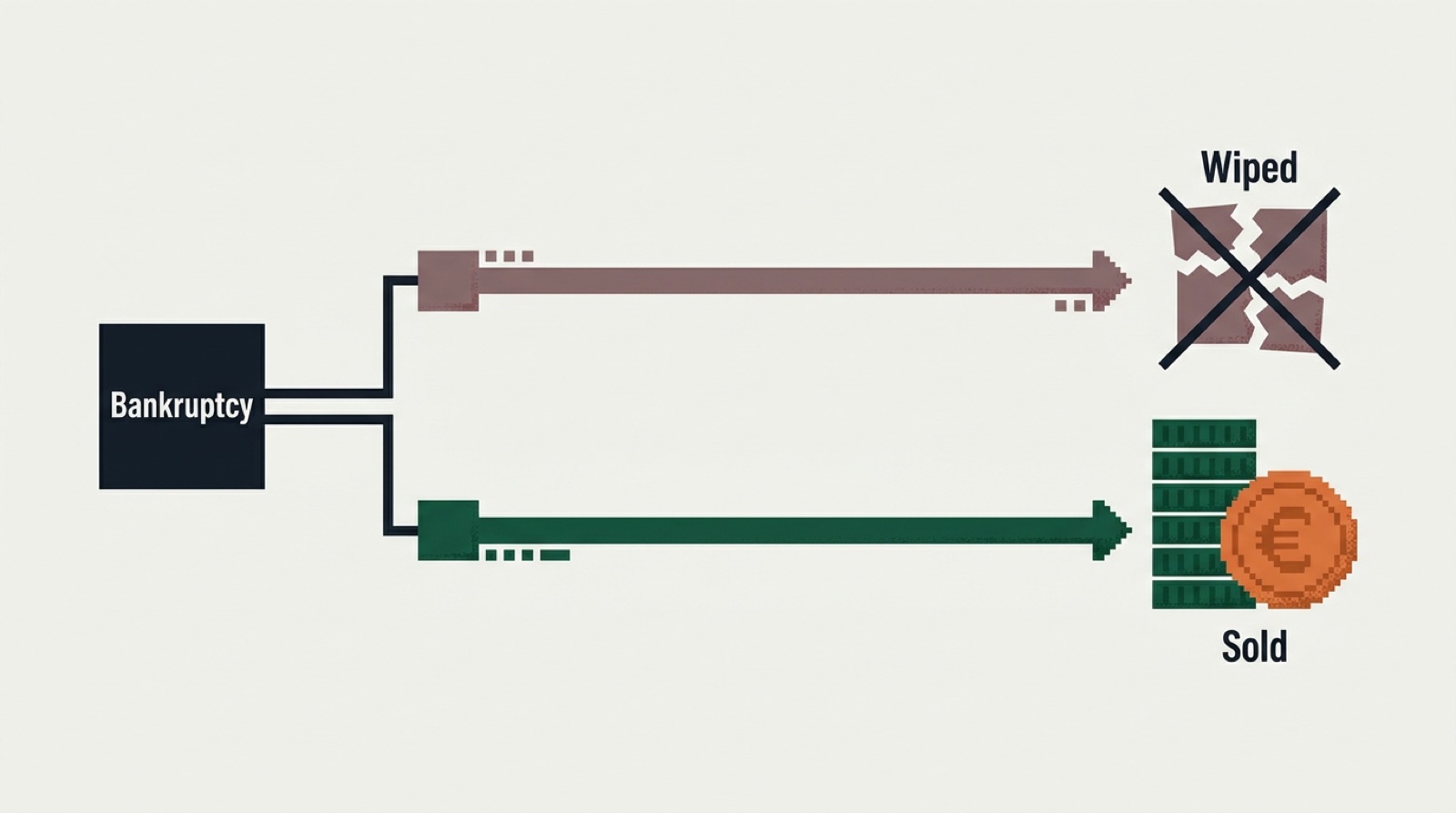
Data in a bankrupt company has no book value and is wiped within weeks. Sold as a fully anonymised dataset, it becomes money for the creditors.
This page is for anyone involved. Founders, directors and shareholders of a company that went bankrupt or is about to. People winding down a startup. Companies in voluntary liquidation. Administrators and liquidators, creditors, and anyone who bought a bankrupt company's assets. Your role decides what you can sign, and we explain that below.
What happens to company data in a bankruptcy?
Without a buyer, it usually disappears. Nobody is assigned to look after it, and every normal step of a wind-down destroys a bit more of it.
- Staff leave. Their accounts are closed or simply stop being paid for.
- Hardware is sold. Laptops and servers go to auction or to an IT disposal firm, and are wiped first to protect the people on them.
- Subscriptions lapse. When Microsoft 365, Google Workspace or Slack is no longer paid, the provider restricts the account and later deletes the data.
- Nobody keeps a copy. The estate keeps what the law requires, such as the accounts. The rest is rarely archived.
None of this is careless. An administrator's job is to turn assets into money and close the estate, and data that appears on no balance sheet is easy to miss. But it means years of records vanish at the very moment they could still be worth something.
It happens a lot. Statistics Netherlands counted 3,636 companies declared bankrupt in 2025, 15% fewer than in 2024 (preliminary figures). In Germany, the Federal Statistical Office registered 24,064 company insolvencies in 2025, 10.3% more than a year earlier and the most since 2014. Not every one of those companies has data worth buying. We work with companies from about 10 people, and the bigger and older the company, the more there usually is.
- Day 1The company is declared bankrupt. Nobody is in charge of the data.
- Week 1Staff leave. Their accounts are closed.
- Week 2Laptops and servers are collected for auction and wiped.
- Week 3Unpaid subscriptions are restricted or downgraded.
- Month 1Mailboxes, chat and files are deleted for good.
- Month 2The estate closes. The data added nothing for creditors.
Is company data an asset in insolvency?
Yes. Data is not on the balance sheet, but it is still the company's property, and in a bankruptcy it falls into the estate. A bankruptcy estate is everything the company owns on the day it is declared bankrupt, managed for the benefit of its creditors. The administrator sells what can be sold and shares out the proceeds.
The catch is that nobody has priced the data. Its book value is zero, so the default is to let it lapse. A buyer changes that. AI labs pay for real records of how a team worked, and Lodex is a route to those labs from Europe.
What we buy
- Slack or Microsoft Teams messages
- Documents in Google Drive, SharePoint or Notion
- Support tickets and Jira or other project boards
- CRM records
- Code with its commit history
- Procedures, playbooks and knowledge bases
A closed company has one advantage here: the history is complete. Years of work, from the first customer to the last day, with nothing still changing. Our pillar on selling Slack, Teams and Jira data explains what each tool teaches a model.
What stays out
- Data the company held for clients as a processor, for example a payroll bureau's client files. It was never the company's to sell.
- Client-confidential material from law firms, accountants, notaries and medical practices, unless it can be properly cleared.
- Health data and national ID numbers, always.
- Third-party content the company had no rights to.
Who owns the data of a bankrupt company, and who can sell it?
The company still owns the data, but someone else decides about it. Once a court opens a formal insolvency, the directors lose control over the company's assets. A court-appointed officeholder takes over, and that person decides whether the data is sold.
| Country | Procedure | Who decides about the data |
|---|---|---|
| Netherlands | Faillissement | The curator, supervised by a supervisory judge (rechter-commissaris) |
| Germany | Insolvenzverfahren | The Insolvenzverwalter |
| France | Liquidation judiciaire or redressement judiciaire | The liquidateur judiciaire; in a redressement, management works with the court's administrateur judiciaire |
| United Kingdom | Administration or liquidation | The administrator or liquidator, a licensed insolvency practitioner |
| Ireland | Liquidation or examinership | The liquidator; in examinership the directors stay in charge, with the examiner involved |
| Before any procedure | Voluntary wind-down or solvent liquidation | The directors, or the liquidator the shareholders appoint |
In some countries a private sale also needs a judge's permission. In the Netherlands, for example, a curator selling an asset outside an auction may need approval from the rechter-commissaris. We prepare what the officeholder needs to ask for it.
Under the GDPR, the party that decides about the data also carries the duties of a controller: the one that determines why and how personal data is processed. The Dutch data protection authority (Autoriteit Persoonsgegevens) wrote to INSOLAD, the Dutch association of insolvency lawyers, in January 2020 that a curator should generally be treated as controller from the date of bankruptcy. Other countries have their own rules, but in practice the officeholder is the one who answers for the data.
If you are a founder, director or shareholder
You know the data best, but after the bankruptcy order you can no longer sign for it. What you can do is tell the administrator the data is there and that a buyer is interested. Then tell us who the administrator is. You know which tools were used, how many years they cover and where the code lives, which makes you the most useful person in the first weeks.
If you are the administrator or liquidator
We make the offer to you. It is a fixed price in writing, with no obligation to accept. We prepare the paperwork, including a description of the deal you can put before the court where permission is required. The proceeds go to the estate.
If you are a creditor or bought the assets
Creditors don't sign, but they gain from a sale, so it is worth raising with the administrator. If you bought a bankrupt company's laptops, servers or the business itself, whether the data came with them depends on what you bought and on the GDPR. Tell us what you have and we check the chain of ownership before we make an offer.
How is selling data from an insolvent company different?
Mainly in who decides and how fast. A trading company can take months to think about it. A bankrupt one has weeks before the data is gone.
| Operating company | Bankrupt company | |
|---|---|---|
| Who decides | The owner or the board | The court-appointed administrator, sometimes with a judge's permission |
| Timing | No rush: the data stays put | Weeks: the data is deleted as the company winds down |
| What happens to the data | Stays in use; you license a copy | Wiped or deleted unless someone buys it |
| Where the money goes | To the company | To the estate, for the creditors |
| History | Still growing, sometimes partial | Complete and closed |
| Worry about rivals | A real concern | Much smaller: the business no longer trades |
Some things don't change. The data is cleaned the same way, data held for clients still stays out, and we still license only to AI labs and research teams under contract. Our step-by-step pillar on how to sell business data covers the parts that apply to every seller.
GDPR and the data of a bankrupt company: can it be sold?
Yes, if it is de-identified properly and the new purpose is assessed. Bankruptcy does not switch off the GDPR. The people in the emails and tickets, staff and customers alike, keep their rights, and the estate must respect them.
The same 2020 letter from the Dutch authority questioned whether selling a customer database to a buyer with a different purpose passes the GDPR's purpose test. That is why we don't sell personal data at all. We deliver a fully anonymised dataset. Names, email addresses, phone numbers, customer names, account and IBAN numbers and addresses are removed, and no one keeps a key to put them back. Health data and national ID numbers are excluded. The originals are deleted once processing is done.
The key matters. Pseudonymised data, where names are swapped for codes and a key is kept somewhere, is still personal data under the GDPR. We keep no key. Our pillar on anonymised company data shows what that looks like record by record, and the guide on whether it is legal to sell company data under the GDPR walks through the purpose test.
In a bankruptcy, the administrator checks a cleaned sample and signs off before anything is sold. Nothing goes to a lab without that approval.
What should you do in the first two weeks?
Keep the data and tell us. The first two weeks decide whether there is anything left to sell. These steps work whether you are the director, the administrator or someone helping them.

- Keep the workspace and accounts alive. Don't cancel Microsoft 365, Google Workspace, Slack, Jira or the CRM yet. If payment stops, ask each provider how long it keeps the data and when it deletes it.
- Don't wipe laptops or servers. If hardware must be sold, hold back the machines that hold the only copy of the data until it is decided what happens to it.
- Keep admin access. Make sure at least one person can still log in as administrator to each tool. Departing IT staff often hold the only passwords.
- List the sources. Write down every tool the company used, roughly how many people used it and how many years it covers. Ten lines in an email is enough.
- Mark what stays out. Note data held for clients, client-confidential files and anything with health data.
- Contact Lodex. Send us the list and the name of whoever is in charge. We make the offer to the person with the authority to accept it.
The longer you wait, the less there is to sell.
If you are not the one who decides, the last step still applies. We contact the administrator, explain the offer and handle the paperwork.
My startup is shutting down: what should I do with the data?
Talk to a buyer before you switch anything off. A startup that winds down before a formal bankruptcy is in a better position than one that waits. The directors still decide, no auction is rushing them, and the data can be sold while the tools still run.
In a voluntary liquidation, the shareholders decide to dissolve a company that can still pay its debts. A liquidator, often one of the directors, sells the assets and pays the creditors. Data is one of those assets, and selling it before the books close adds to what is left for creditors and shareholders.
One caution. If the company is close to insolvency, a sale it makes now may later be reviewed by an administrator. You want a fair price, agreed in writing with an independent buyer, on file. Our offer is a fixed price in writing. Ask your own lawyer if you are unsure.
For a software startup, code is often the most valuable part. A repository with its full commit history shows how a product was actually built, mistakes included. Our guide to what AI labs buy lists the data types labs ask for most.
How does a sale work, and how much is the data worth?
A sale takes the same steps as for any company, with the administrator in the owner's seat. From first call to payment usually takes two to three weeks. A judge's permission, where it is needed, can add time.
- Tell us which tools the company used and who is in charge of the estate.
- Call (20 minutes): we go over the sources and agree in writing what's in and what's out.
- Offer: we assess the data and make a fixed price in writing, with no obligation to accept.
- Secure handover: encrypted, read-only access to the approved sources, under NDA from day one.
- Cleaning: names, customer details and other identifiers are removed during processing.
- Approval: the person who signs checks a cleaned sample and signs off.
- Payment: the money is in the seller's account, in a bankruptcy the estate's, within 7 days after the data passes review.
Company data could fetch €10K–€600K. Larger or specialised datasets can earn up to hundreds of thousands of euros. That is not a guarantee. The price depends on headcount, years of history, how specialised the work was, the language and how much survived the wind-down. Our pillar on why business data is worth money explains what drives it.
We license the dataset only to AI labs and research teams under contract. Buyers see redacted samples only, and the full package is released after they pay. Nothing is published.
Questions
Can a curator sell company data?
Yes. A curator can sell the data in the estate like any other asset, as long as the GDPR is respected. In the Netherlands a private sale may need permission from the supervisory judge (rechter-commissaris). Lodex makes the offer to the curator and prepares the paperwork.
Who gets the money when a bankrupt company's data is sold?
The estate. The administrator shares the proceeds out among the creditors in the order the insolvency rules set. Shareholders only see money if every creditor is paid in full first.
Can I sell the data myself as the former director?
Not once a formal bankruptcy has been declared. From that moment the administrator controls the company's assets, including its data. You can still help a lot by telling the administrator the data exists and putting them in touch with us.
What happens to Slack and Microsoft 365 data when a company stops paying?
The account is first restricted or downgraded, and the data is deleted later. How long that takes differs per provider and plan, so check it early. Once deleted, it usually cannot be recovered.
Is it too late if the laptops have already been sold?
Not always. Much of a company's data lives in the cloud: email, chat, document storage, ticketing tools and code hosting. As long as those accounts still exist, there may be plenty to sell, so contact us with what is left.
Does Lodex buy data from small bankrupt companies?
We work with companies from about 10 people. Below that there is rarely enough data for a lab to buy. Size is not everything, though: a specialised firm with years of history can be worth more than a bigger generic one.
Does Lodex buy data from bankrupt companies outside the Netherlands?
Yes. Lodex is run from the Netherlands, works under the GDPR and handles data in 8 languages. Who signs differs per country, and we make the offer to the officeholder of whatever procedure applies.
Will the details of employees and customers be sold?
No. We deliver fully anonymised datasets: names, email addresses, phone numbers, customer names, account numbers and addresses are removed and no key is kept. Health data and national ID numbers are excluded, and the originals are deleted after processing.
This page explains how Lodex works and is not legal advice. Insolvency and data protection rules differ per country and per procedure, so check with the administrator or your own lawyer before you act.