What should you do with company data when you close a business?
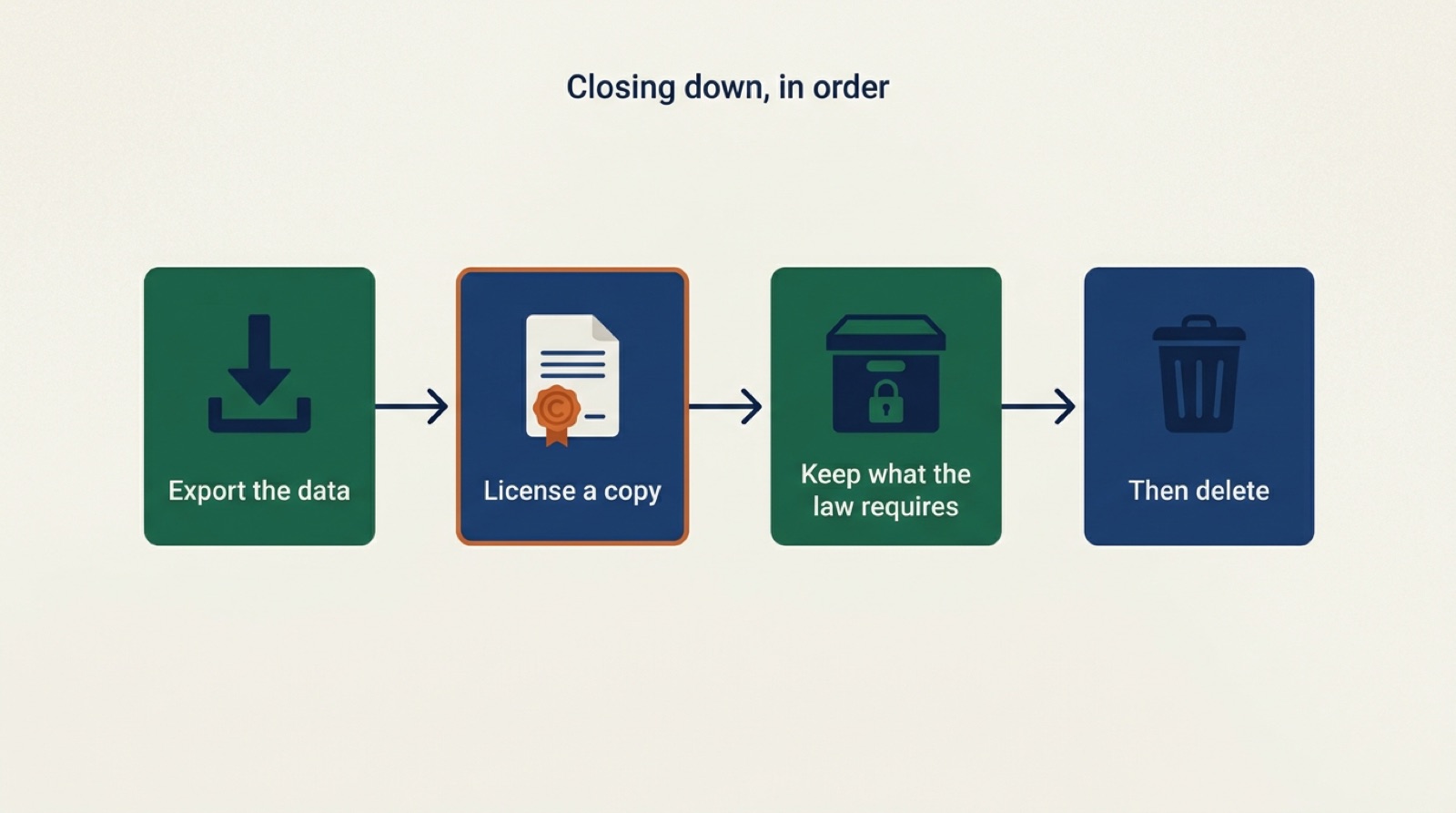
Sort it into three piles: what the law makes you keep, what you can sell and what you delete. Then do it in that order: export first, sell second, delete last.
A practical rule for your closing checklist: nothing gets cancelled, wiped or deleted until it has been exported. Put that line at the top.
A wind-down is the planned closing of a company that can still pay its bills. The owner retires, there is no successor, or the shareholders decide to stop. It is not a bankruptcy. Nobody takes control away from you, so you decide what happens to the data.
The order is the whole point. Most closing checklists put "cancel subscriptions" near the top and "delete data" at the end. Do it that way and the most valuable thing left in the company disappears in between.
Is the company insolvent, or close to it? Then the rules change, because an administrator may decide instead of you. Our page on selling data from a bankrupt company covers that case.
Why is your company data worth money when you close?
Because AI labs pay for real work records, and a closing company has years of them. Email, chat, documents, tickets and code show how people actually do their jobs. That is what labs need to train and test AI that can do work too.
Buyers already look for closing companies. In October 2026, MIT Technology Review reported that AI labs are buying data from startups that shut down. One broker, SimpleClosure, had handled more than 150 such deals, and 47% of its deals now include a sale of code or data. One founder got about US$25,000 for his code base.
A closed company's history is also finished. Every project in it has a start and an end, which is exactly what labs need to build realistic tasks. Nobody is still editing the files.
Company data can fetch €50K–€600K, and strong datasets reach €100K+. The price follows what is in your records, not the reason you are closing. Our guide on what your company data is worth explains the factors.
What can you sell, and what must you keep?
These are two different piles with different rules. The law decides what you keep. You decide what you sell.
| Data | Keep it? | Sell a copy? | Why |
|---|---|---|---|
| Invoices, ledgers, bank statements, contracts | Yes, for the legal period | Usually not | Tax law requires them, and they say little about how work is done |
| Email and chat (Outlook, Gmail, Slack, Teams) | Only what the law asks | Yes, cleaned | Shows how professionals write, decide and hand over work |
| Documents and project files | Only what the law asks | Yes, cleaned | Proposals, reports and plans show finished work |
| Tickets, work orders, CRM notes | Rarely | Yes, cleaned | Each one is a real task from start to finish |
| Code with its history | No | Yes | Labs use it to train and test coding agents |
| HR files, medical data, ID numbers | Only what the law asks | Never | Too sensitive, so it stays out of every sale |
| Data you process for clients | Return or delete it as the contract says | Never | It belongs to your client, not to you |
How long you keep the books depends on the country. In the Netherlands, business.gov.nl says you must keep business records for at least seven years, and that this still applies when your business stops trading. Other EU countries set their own periods. Your accountant knows yours.
Keeping and selling don't clash. A licence covers a cleaned copy. Your originals, and the duty to keep some of them, stay with you.
What goes wrong if you cancel first?
The data disappears on the provider's timetable, not yours. Four things usually go wrong.
Subscriptions delete what they hold
When you stop paying, providers restrict the account and later delete the data. Slack's free plan deletes messages and files older than a year. Google's full export tool only works while the subscription is still active. Export first, then cancel.
Laptops get wiped and sold
Old laptops and servers usually go to a reseller or a recycler, wiped clean. Anything that only lived on a hard drive goes with them. Copy shared folders and local project archives before the hardware leaves.
The company can no longer sign
A company that has been dissolved can't sign a contract any more. License the data while the company still exists, and the money goes into the final accounts like any other sale.
The people who know leave too
The IT lead, the office manager and the longest-serving staff know where everything is: the old mail server, the archive drive, the tool you replaced in 2019. Ask them to list every tool and archive before their last day. Data is worth most while someone can still explain it.
Pick a closing task below to see what happens if you do it first, and what to do instead.
Pick a closing task.
- If you do it first
- The provider restricts the account and later deletes it. Google's full export no longer works once the subscription is cancelled.
- Do this instead
- Run every tool's export first. Keep paying for the month the exports take.
General advice, not legal advice. Your accountant or lawyer knows the rules for your country.
Is it legal to sell company data when you close down?
Yes, if the data is yours and the personal details come out first. Closing doesn't switch off the GDPR. You stay responsible for the personal data you hold until it is deleted.
Your duties under the GDPR don't stop when the company stops. They stop when the personal data is deleted or truly anonymised.
That is why we clean before anything leaves. Names, email addresses, phone numbers, street addresses and account numbers are removed or replaced, and no key is kept to put them back. Our page on how we anonymise company data shows a record before and after.
Tell your staff, too. They wrote much of what is in the email and chat. A short note on what is happening, and what is removed, avoids surprises and gives them a way to object.
Two things stay out whatever happens: data you hold on behalf of clients, and anything with health data or national ID numbers. The GDPR guide to selling company data goes through the rest step by step.
How long does a sale take before you close?
Usually two to three weeks from the first call to a cleaned dataset. Plan it into your closing timeline, before the last month you pay for your tools.
- Estimate. Your company size, years in business and country give a first range in a minute.
- Call. We go through your tools and agree what is in and what stays out.
- Offer. A fixed price in writing. You can say no.
- Export. You or your IT person run each tool's own export and upload it. Our guide to preparing company data for an AI lab shows how, tool by tool.
- Cleaning and approval. We remove the personal details. You check a sample and sign off.
- Payment. Within 7 days of the buyer paying Lodex.

Then you close as planned. Keep the books for the legal period, delete what you no longer need and cancel the subscriptions. Lodex charges you nothing for any of this.
Who signs when a company closes?
Whoever can sign for the company at that moment. In a wind-down that is usually the director, or the liquidator the shareholders appoint. In a bankruptcy it is the administrator.
A liquidator is the person who winds up a company: they sell what is left, pay the creditors and hand any surplus to the shareholders. In a small company this is often the director. Data is one of the things a liquidator can sell.
One caution if money is tight. A sale made just before an insolvency may later be reviewed. A fixed price in writing, from an independent buyer, is what you want on file. Ask your own lawyer if you are unsure.
Selling the business instead of closing it? Then the data normally goes to the new owner along with everything else. If you want to license a copy first, agree it with the buyer in the sale contract. Our page on what to do before selling your business covers the timing and what to tell the buyer.
Licensing and selling are not the same thing, by the way. A licence lets a lab use a cleaned copy for training. Our page on licensing company data to AI explains the difference.
What is the data from a closing company worth?
Company data can fetch €50K–€600K. What decides the price is what is in the records.
- Years of history. Ten years of email and projects beats two.
- People. More staff means more conversations, decisions and handovers.
- Free text. Notes and messages in people's own words are worth more than forms.
- Links. A ticket that links to the email, the document and the invoice tells a complete story.
- Language and specialism. Work in Dutch, German or Polish, or in a niche trade, is hard for labs to find.
- Completeness. Every mailbox and channel is worth more than a handful.
Small companies count too, from about 10 people with several years of digital records. Old systems you stopped using still count, as our page on making money from old company data explains.
The estimate below gives a first range in a minute. If you are planning to close, do it before you cancel anything. More about who we buy from is on the page for companies.
Questions
Can I sell my company's data when I close the business?
Yes. A closing company can license a cleaned copy of its email, chat, documents, tickets and code to AI labs, as long as the data is its own and personal details are removed. Do it before you cancel subscriptions or wipe laptops, while the company can still sign.
How long do I have to keep business records after closing?
It depends on the country. In the Netherlands you must keep business records for at least seven years, also after you stop trading. Ask your accountant for the rules in your country.
Do I have to delete customer data when I close my company?
You must delete personal data you no longer need, except what the law makes you keep, such as invoices. Properly anonymised data falls outside the GDPR, so a cleaned copy can be licensed before the originals are deleted.
What happens to our Slack and Google Workspace data when we cancel?
The provider restricts the account and later deletes the data. Slack's free plan deletes messages and files older than a year, and Google's full export needs an active subscription. Export everything before you cancel or downgrade.
Is it too late if we already cancelled some tools?
Not always. Providers often keep data for a while after a subscription ends, so ask each one how long. Exports you already made, and files still on a server or drive, count too.
Who gets the money from the data?
The company that owns the data, so it goes into the final accounts like any other sale. Lodex pays within 7 days of the buyer paying Lodex.
Does Lodex buy data from small companies that are closing?
Yes, from about 10 people with several years of digital records. The estimate on this page gives a first range in a minute.