For AI labs
Licensed European AI training data from real work
Lodex licenses de-identified work data from European companies to AI labs: conversations, tickets, code with its history, documents and process logs, in 8 languages. Every dataset comes with a training licence from the company that owns it and a record of where each file came from.
Labs working with Lodex
- European companies in our seller network
- 1,100
- sectors, from accounting to logistics
- 20
- median company history
- 15 years
- European languages
- 8
Counted on 15 October 2026. Companies in talks with Lodex about licensing their data, most of them in the Netherlands and Belgium.
Why is European training data so hard to find?
Because the data labs need most was never published. The public web is mostly English, and the way companies actually work (support threads, internal chat, code reviews, finished client files) sits inside their own systems. The only clean way to get it is to license it from the company that owns it.
The web is mostly English
In Common Crawl's September 2026 crawl, English is 41.9% of pages. Dutch is 1.7%, Polish 2.0% and Swedish 0.7%. The seven other languages Lodex sources add up to about 22% together (Common Crawl language statistics).
Public text is running out
Epoch AI puts the stock of public human text at about 300 trillion tokens and expects models to use it all between 2026 and 2032. It also notes that private data such as messages is hard to use at scale for legal reasons (Epoch AI). Licensing is how that changes.
Real work never reaches the web
A ticket that took three replies to solve, a contract with its redlines, a pull request and the bug it fixed: none of it is crawlable. It is exactly what agents and enterprise models are judged on.
Source: Common Crawl crawl CC-MAIN-2026-39, share of HTML pages by primary language.
What company data can AI labs license?
Five standard datasets, each cut from the systems a company already runs. We are collecting now: tell us your spec and you get a datasheet within 5 business days and a sample under NDA within 4 to 6 weeks.
Workplace conversations
Multi-party threads from chat and email, with roles, timestamps and replies kept in order. How decisions get made, handed over and followed up.
- Typical sources
- Slack
- Microsoft Teams
- Gmail
- Outlook
- Used for
- Post-training, agent training, evals
- Delivered as
- JSONL with a datasheet and Croissant metadata
Ticket to resolution
Helpdesk and IT tickets from first message to close, with every reply, internal note and the outcome attached: solved, escalated or refunded.
- Typical sources
- Zendesk
- Freshdesk
- Jira Service Management
- TOPdesk
- Used for
- RL environments, support agents, evals
- Delivered as
- JSONL with a datasheet and Croissant metadata
Code with history
Private repositories with their commits, pull requests, review comments, issues and CI runs. Years of real engineering, not benchmark puzzles.
- Typical sources
- GitHub
- GitLab
- Bitbucket
- Jira
- Used for
- Coding agents, RL environments, pre-training
- Delivered as
- JSONL with a datasheet and Croissant metadata
Document work
The inputs and the finished deliverable side by side: an accountant's year-end file, a consultant's report, a lawyer's contract and its versions.
- Typical sources
- SharePoint
- Google Drive
- Exact
- AFAS
- Used for
- Expert tasks, long-form generation, evals
- Delivered as
- JSONL with a datasheet and Croissant metadata
Process logs
CRM and ERP flows with the result attached: a lead that was won or lost, an order that shipped, an invoice that was paid late.
- Typical sources
- HubSpot
- Salesforce
- Odoo
- Microsoft Dynamics
- Used for
- Enterprise agents, RL environments, forecasting
- Delivered as
- JSONL with a datasheet and Croissant metadata
 TOPdesk
What does one record look like?
Every record keeps the structure a model learns from and loses what identifies a person or a client. Names, emails, phone numbers, addresses and account numbers become typed tags, so a thread still reads as a thread.
- Customer · 09:14
Hi, this is Sanne de Vries from Bakkerij Holtkamp. Our order #58213 arrived without the cooling unit. Can you call me on 06 4821 7730?
- Agent · 09:31
Sorry about that, Sanne. I've booked a courier for tomorrow before 12:00 to Lindengracht 41, Amsterdam. Reference RMA-2291.
- Outcome
Status: solved in 2 replies · First response 17 min · Agent Joost Meijer
A synthetic example written to show the format. Not a real record.
- thread
- Messages in order, each with a role (customer, agent, internal) and a timestamp.
- outcome
- What happened in the end: solved, escalated, won, merged, paid.
- language
- ISO code per message; mixed-language threads stay as they were.
- source
- The system it came from and the export date.
- rights_id
- Links the record to its licence and provenance record.
How do you verify provenance and rights?
Every dataset ships with a provenance pack your legal and privacy teams can check before any data moves. Deals in this market rarely fail on price; they fail on rights. So we do the rights work first.
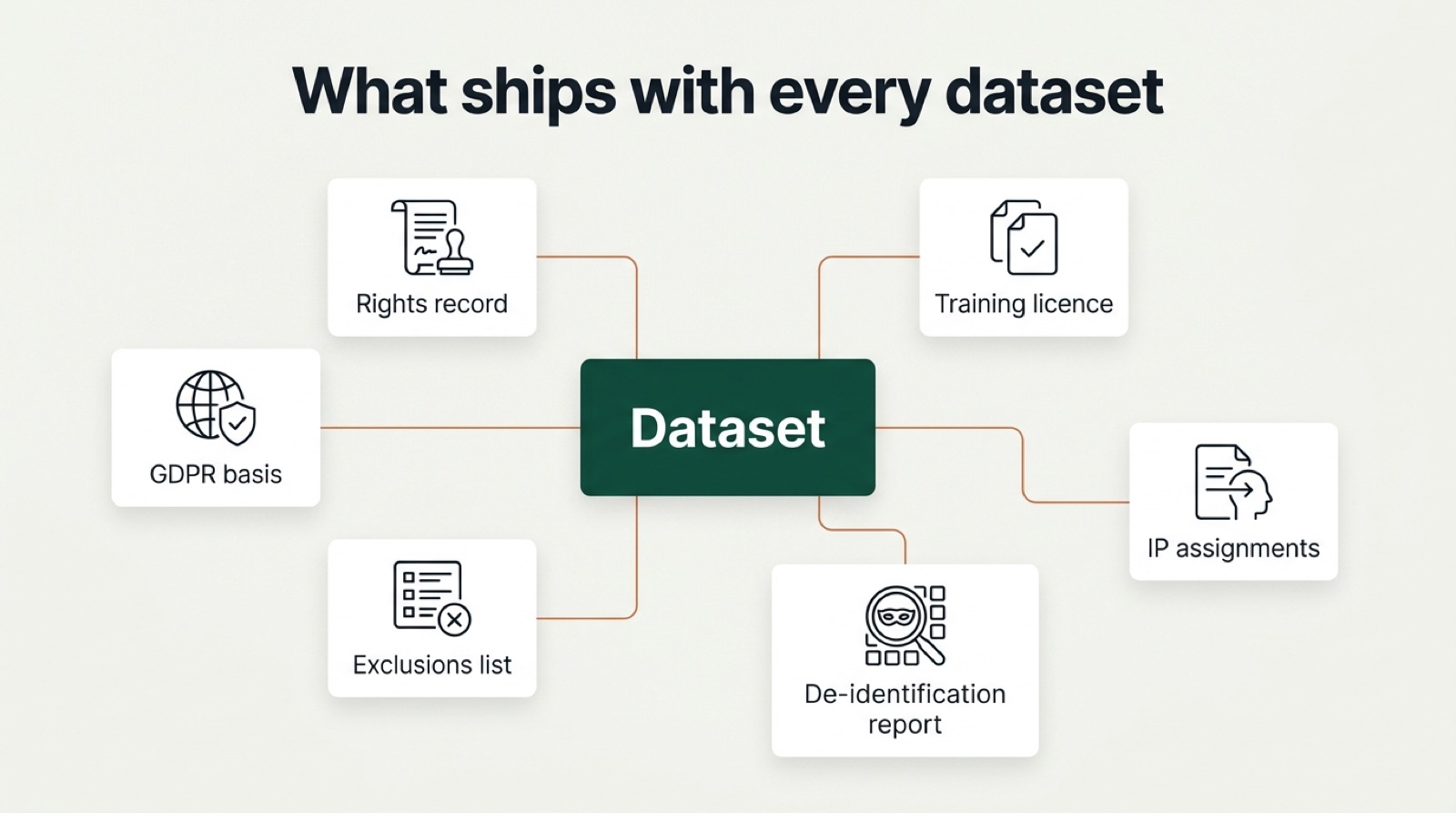
Rights record
Per asset: who owns it, which system it came from, when it was exported and under which agreement.
Training licence
Signed by the company that owns the data, explicitly allowing training and evaluation. Non-exclusive by default.
IP assignments
For code and documents: confirmation that employee and contractor work belongs to the company.
De-identification report
What was removed or replaced, how, and the checks run on a sample of the output.
Exclusions list
What stayed out: client-confidential files, data held for others, contracts that forbid reuse, special categories.
GDPR basis
The legal basis for processing, documented per source. Files are stored in the EU.
Under Article 53 of the EU AI Act, providers of general-purpose models publish a summary of their training content, using a template the European Commission released in July 2025 (European Commission). Our provenance pack records source, type and licence per dataset, so the facts that summary asks for are already written down.
Want to move faster? Ask for our licence template and have your counsel mark it up now, so diligence is done before the sample lands.
How does buying data from Lodex work?
Six steps, with the sample and the legal review running side by side.
- 01
Within 1 business day
Your spec
Data types, languages, sectors, minimum history and volume. The form at the top takes two minutes.
- 02
Within 5 business days
Datasheet
Which companies match, record counts, history and a redacted preview of the format.
- 03
Same week
NDA and licence
A mutual NDA, and our licence template to your counsel.
- 04
Within 4 to 6 weeks
Sample
A de-identified sample under NDA, cut from the matching companies, to run through your own pipeline.
- 05
Your call
Licence
Non-exclusive by default. An exclusive window is possible and priced separately.
- 06
Milestones
Delivery
Delivered in parts with acceptance criteria, each with its provenance pack.
Need data you don't see listed?
Tell us what your model is missing. We take your spec to the 1,100 companies in our network, find the ones whose systems hold it and come back with a datasheet. The company sees what a lab is asking for, never which lab.
That includes the material for RL environments and evals. Epoch AI names enterprise workflows as a major growth area for RL environments, many of them built as clones of tools like Slack or SAP (Epoch AI). Real tickets, threads and process logs from those same tools make the tasks and their pass or fail signal realistic.

- A language or region: Dutch and Flemish first, then German, French, Spanish, Italian, Polish and Swedish.
- A sector: accounting, legal, IT services, consulting, finance, logistics, construction and more.
- A depth: minimum years of history, systems that connect (a ticket linked to its code change), outcomes attached.
Questions
Where can AI labs buy licensed training data from European companies?
Lodex licenses de-identified work data from European companies to AI labs: conversations, tickets, code, documents and process logs. Each dataset comes with a training licence signed by the company that owns the data and a provenance pack. Send a spec through the form on this page and you get a reply within 1 business day.
Is it legal under GDPR to train AI on de-identified company emails and chat?
It can be, when the company has a legal basis to share it, personal data is removed or replaced before it leaves, and the result is checked. Lodex documents the basis per source, replaces names, contact details and identifiers with tags, and keeps special-category and client-confidential material out. The GDPR basis is part of the provenance pack.
How do I get Dutch, German, Polish or Swedish training data that isn't scraped?
License it from companies that work in those languages. Lodex sources business data in 8 European languages, starting with Dutch and Flemish, and keeps the original language and any language mixing in each thread. Specify the languages and the minimum volume in the request form.
What does the EU AI Act require for licensed training data?
Providers of general-purpose AI models must publish a summary of their training content under Article 53, using the European Commission's template. The obligation has applied since 2 August 2025, with models already on the market given until 2 August 2027. Lodex's provenance pack records the source, type and licence of every dataset so that information is ready.
How is company data de-identified before it is sold to AI labs?
Names, emails, phone numbers, addresses, account and order numbers are replaced by typed tags such as PERSON_1 or PHONE_1, consistently within a thread. Details that identify someone by context, like a unique job title, are generalised or dropped. Each dataset ships with a de-identification report.
How much does enterprise training data cost?
It depends on the volume, the years of history, how connected the systems are and whether you want exclusivity. Public reference points range from $10,000 to $100,000 per company for wind-down data to $200 to $2,000 per RL task. Lodex quotes per dataset after the datasheet.
Is the data exclusive?
Non-exclusive by default, which keeps the price down and is how most data licensing works. An exclusive window for a dataset, a sector or a language is possible and priced separately.
Is licensed real-work data better than synthetic data for agents?
They do different jobs. Synthetic data scales a pattern you already know. Real work data shows the patterns you don't: how a customer actually phrases a complaint, which replies solve a ticket, how code changes after review. Many labs use real data to seed and check their synthetic pipelines.
Do you sell to labs outside Europe?
Yes. Lodex licenses to AI labs and data vendors worldwide, including the United States and Asia. The data is stored in the EU, and every licence follows the same provenance and de-identification rules.